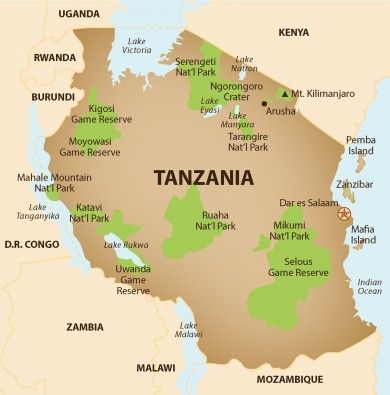
Summary Facts for Tanzania
- Capital City: Dodoma
- Total Area: 943,000 sq km.
- Population: 40 million people
- Languages : English and Swahili.
- Religions: Christians 40% to 45%, Muslims 35% to 40%, traditional beliefs are also important.
- Government: Republic.
- Independence Date: 9th of December 1961.
- Agriculture: Coffee, Tea, Cotton, sisal, cloves.
- Climate: Tropical
Tanzania National Facts
The United Republic of Tanzania is a nation in central East Africa bordered by Kenya and Uganda to the north, Rwanda, Burundi and the Democratic Republic of the Congo to the west, and Zambia, Malawi and Mozambique to the south. The country’s eastern borders lie on the Indian Ocean.
The United Republic of Tanzania is a unitary republic composed of 26 mikoa (regions). The current head of state is President John Pombe Magufuli, elected in 2015. Since 1996, the official capital of Tanzania has been Dodoma, where parliament and some government offices are located. Between independence and 1996 the major coastal city of Dar es Salaam had been the country’s political capital. Today Dar es Salaam remains the principal commercial city of Tanzania and the de-facto seat of most government institutions. It is the major seaport for the country and its landlocked neighbours.
The name Tanzania is a portmanteau of Tanganyika and Zanzibar. The two states united in 1964 to form the United Republic of Tanganyika and Zanzibar, which later the same year was renamed the United Republic of Tanzania.
Credit cards are only accepted by the major airline companies and by most of the bigger hotels and lodges. Do not rely on credit cards as a source of cash while in Tanzania. In some cases a surcharge will be added to credit card payments. We suggest that you take sufficient cash and use the credit card as a back-up only. Travellers checks are accepted at most banks and some hotels, however a surcharge normally apply to exchange travellers checks into cash. Please note many shops / hotels don’t accept travellers checks.
Climate
There are two seasons of rain in Tanzania: the long rainy period (monsoon) which runs from late March until June and a short rainy period, which runs from November until mid January. The long rains fall in heavy downpours, often accompanied by violent storms. The short rains tend to be much less severe.
Duty free
The following is duty free:
- 250g of tobacco
- 50 cigars
- 200 cigarettes
- One litre of wine
- 0.25 litres of perfume
Electricity
The local electricity supply is 220 volts, 50 cycles ac. You will need to supply your own international standard adapter for your electrical appliances.
About Malaria
Malaria occurs below 1800 meters and you should use the recommended prophylactics. Please consult your doctor about these. Woman using oral contraceptives should consult their physicians before using prophylactics. The best way to prevent contracting Malaria is to try and avoid mosquito bites by using an effect insect repellent, by sleeping under mosquito nets and to wear proper clothing after sunset. Meningitis can be present during the dry seasons.
Recommended Immunisations
As a sensible precaution we recommend that you consider getting at least some of the following recommended immunisations:
- Hepatitis A & B
- Typhoid
- Cholera
- Tetanus (lockjaw)
When you travel to Tanzania, there are no mandatory vaccinations, but you are urgently advised to get some of them.
DTP (Diphtheria, Tetanus and Polio): If you are previously vaccinated (such as in childhood) it is sufficient to have one injection every 15 years. When this is not the case, you should get two DTP injections with at least an interval of four weeks before you leave and get third one after six months. The duration of the protection is 15 years.
Yellow fever: At least 10 days before departure the injection must be obtained. The duration of protection is 10 years. When you travel to multiple destinations in Africa a stamp for proof of vaccination is mandatory.
Hepatitis A: one vaccination for hepatitis gives protection for a year and can best be obtained two weeks before departure. When another vaccination is administered after half a year of the first one the protection lasts ten years.
It is also increasingly advised to include Hepatitis B to your vaccination list as well. Most of Tanzania is also considered a malaria area and you can take various types of anti-malarial drugs for prevention. The recommendations may change and it is important to speak to a specialist for the exact information that applies to you.
By far the best way to prevent getting malaria is to make sure mosquito's simply can not bite you. We recommend that you bring along a good anti-mosquito repellent with a high percentage of DEET. For the tours we organize, it is not necessary to bring a mosquito net with you, unless specifically stated otherwise.
Please check with your local travel clinic for the latest recommendations.
Immigration & customs
An onward ticket and sufficient funds are required when entering Tanzania. Tanzanian people are friendly and will always offer a helping hand.
A passport is required that is still valid for at least six months after the date of departure. A visa is required and costs approximately EUR 50.00 or USD 50,00 per person. The visa can be obtained at the Tanzania Embassy in your country or upon arrival at one of the international airports of Tanzania (not applicable to all nationalities). For a visa application in Tanzania, you do not need a photograph or a copy of a ticket, which are required by the embassies.
Insurance
It is strongly advised to take out travel insurance which should cover baggage as well as personal accident and medical insurance and specifically covering your Kilimanjaro expedition.
Language
The official languages are Ki-Swahili and English. There are more than 120 tribal vernaculars.
Religion
Mainly Christian, Muslim and Traditional beliefs. Please keep in mind that you are entering a different country with strong religious customs.
Security
As with any other town, walking alone at night is not advisable, and it is preferable to use taxis which are available at most hotels. Do not leave cash or valuables in your hotel room and use a safe deposit box.
Make use of a safe deposit box to keep your belongings safe, and do not leave anything of value lying around in your hotel room.